
How to Build Emotional Resilience to Survive Tough Times
We all face hard seasons in life. Sometimes things go smoothly. Other times, unexpected storms knock the wind right out of us.
You might deal with job stress, family issues, or sudden heartbreak. During these tough moments, you need something sturdy to hold onto. That anchor is called emotional resilience.
Emotional resilience is not about pretending everything is fine. It does not mean you never cry or never feel overwhelmed. Instead, it is your ability to bend without breaking when life gets hard. It is like a muscle that grows every time you practice using it.
As organizational psychologist Adam Grant noted in an Inc. Magazine feature, "Overcoming adversity takes time. Resilience is not about how quickly you bounce back–it's about how fully you recover."
In this article, we will walk through how you can build real emotional resilience to stay strong, peaceful, and grounded no matter what life throws your way. But before that, let us look at why building emotional resilience is important.

Why is it Important to Build Emotional Resilience?
Tough times are a normal part of life, and they put strain on your body and mind. Without resilience, long-term stress will wear away your health, focus, and relationships.
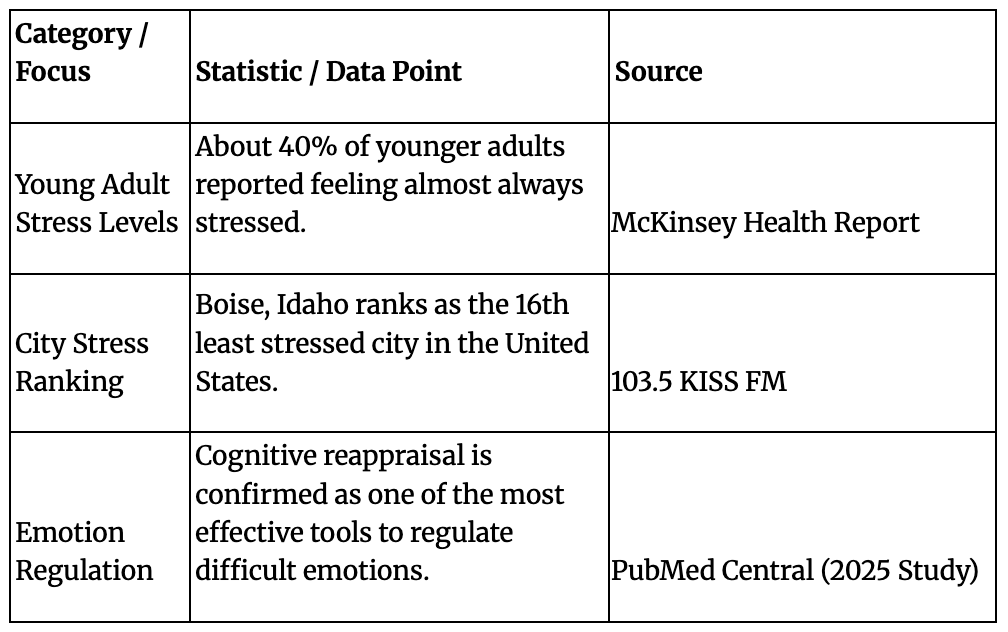
Recent studies show that many people feel this strain. In a health report by McKinsey, about 40% of younger adults reported feeling almost always stressed.
Building emotional resilience protects your body and mind from constant stress, which can ruin your sleep, heart health, digestion, clear thinking, and happiness. It also improves your relationships. When you handle stress well, you become more patient, listen better, and forgive more easily, rather than reacting in anger.
Many Americans seek emotional strength, and even those living in the least stressful areas are not an exception. Boise, Idaho, is a case in point. An article published on 103.5 KISS FM reveals that Boise ranks among the least stressed cities in the country.
However, residents still fight unseen battles beneath the surface. In Ada County, where Boise is located, health reports show the population’s ongoing struggle with substance abuse and fentanyl misuse. Using drugs or alcohol to manage severe stress and pain can easily lead to dependency.
At such times, professional help is necessary for recovery. Dedicated residential programs based in Boise offer a safe, structured space to heal, reset, and build lasting emotional strength.
According to Icarus Wellness and Recovery, a leading Idaho treatment center, these facilities help residents safely withdraw from alcohol, opioids, and benzodiazepines through medical detox, followed by tailored inpatient care.
How to Build Emotional Resilience to Stay Strong During Life’s Challenges
You do not need to make huge life changes overnight. Building emotional resilience happens through simple, daily choices. Here are three practical steps you can start practicing right away.
1. Shift Your Perspective with Cognitive Reappraisal
The way you look at a problem determines how much power it has over you. In psychology, this shift in perspective is called cognitive reappraisal, and it directly changes how you feel.
A 2025 study published in PubMed Central confirms that cognitive reappraisal is one of the most effective tools to regulate tough emotions. Rather than jumping to the worst-case scenario, you pause to look for alternative explanations.
Practice daily reframing with these three steps:
Name the thought: When panic hits, write down the exact sentence in your head. Seeing it on paper takes away some of its power.
Look for evidence: Ask yourself if you know for sure that this bad outcome is true right now. Most of the time, the answer is no.
Find the neutral angle: You do not need toxic positivity; simply aim for a neutral truth. Remind yourself that while this is a difficult moment, you have handled tough times before.
Changing how you view a challenge helps your brain switch from panic mode to problem-solving mode.
2. Establish Daily Micro-Habits That Recharge Your Nervous System
Your emotions live in your body. When stress sets in, your heart beats faster, your muscles tighten, and you take shorter, shallower breaths. If you stay in that tense state for too long, your emotional resilience drops quickly.
To be emotionally resilient, you must teach your nervous system how to return to a state of calm. You do not need hours of free time to reset. Tiny, daily habits can signal to your brain that you are safe.
Try these two simple micro-habits throughout your day:
Take a physiological sigh: Take two quick inhales through your nose, then a long, slow exhale through your mouth. Doing this three times lowers your heart rate.
Get morning sunlight: Step outside in the sunlight for ten minutes after waking up. Natural light balances your mood and helps you sleep better at night.
Regularly doing these quick resets helps your body manage pressure with ease, so you stay calm and recover quickly when life gets chaotic.
3. Focus on What You Can Control and Release the Rest
A lot of our emotional pain comes from trying to fix things we cannot control. You cannot control the weather, the economy, traffic, or how other people act. Trying to control those things will only leave you feeling exhausted.
Emotionally resilient people put their energy where it actually matters. They draw a clear line between what is their business and what is not.
To protect your peace, divide your challenges into two simple buckets:
What you can control: Your daily habits, your sleep schedule, the words you choose, how you treat others, and how you react when plans fall apart.
What you must release: Other people’s moods, past mistakes, online opinions, and sudden delays.
Whenever you feel overwhelmed, stop and ask yourself if you can fix it right away. If the answer is yes, take one small, positive action. If the answer is no, take a deep breath and let it go. Fighting reality will not change the outcome; it only drains your strength.
FAQs on Cultivating Emotional Resilience
Can emotional resilience be learned later in life?
Yes. Your brain can build new pathways at any age, allowing you to learn and strengthen resilience over time.
What is the difference between resilience and mental toughness?
Resilience focuses on adapting and healing from stress, while mental toughness pushes through hardship without addressing emotional recovery.
How long does it take to build emotional resilience?
Most people notice positive changes in their stress levels within a few weeks of practicing daily resilience habits.
Useful Statistics on Stress and Resiliency
Being emotionally resilient does not mean you will never feel sad, scared, or angry. True resilience means you give yourself permission to feel those hard emotions without letting them take the steering wheel.
Be patient with yourself on this journey. Some days you will handle problems with grace, and other days you might feel tired and grumpy. That is completely normal.
You have gotten through hard seasons before, and you have the strength to navigate whatever comes next. Take it one day, one breath, and one choice at a time.